
Back to School: Rethinking the Future of Education in Europe
On 31 August 2026, the ECIT Foundation brought together academics, policymakers, youth leaders, and civil society representatives in Brussels and online to rethink the role of citizenship education, European mobility, and skills portability across the EU.
The event opened with an afternoon workshop at the offices of our pro bono partner Paul Weiss, where ECIT co-founder Tony Venables was joined by Chiara Piccolo (Learning for Wellbeing Foundation), Olivia Lori Iglesias Ucendo (European Youth Forum), Thérésa Elhage (AllDigital), and Anneline Vandeput (Erasmus Student Network Belgium) to explore the strategic potential of our All On Board European Citizens’ Initiative (ECI).
The day concluded with a high-level plenary at the Merode, moderated by ECIT co-founder and ECI Representative Suzana Carp. Keynote speakers Isabella Lenarduzzi (JUMP Europe) and Michael McLoughlin (Youth Work Ireland) shared personal narratives and strategic insights, distilling the afternoon’s debates into actionable steps for the wider audience.
Context: An Ambitious Project in Challenging Times
Europe faces a convergence of political, social, and economic pressures. Rapid information flows, growing political polarisation, and rising Eurosceptic narratives are straining democratic life. Additionally, these challenges disproportionately affect vulnerable citizens. At the same time, individualisation and declining participation in collective life are weakening community bonds and social tolerance. With far-right movements gaining influence across Europe, democratic institutions are under pressure. This reality raises a fundamental question: How can European citizens be better equipped to actively participate in and protect democracy?
To address this, the ECIT Foundation developed the All On Board ECI, built on three interconnected pillars:
- The right to citizenship education: Giving every citizen the tools to understand their EU rights, responsibilities, and democratic power.
- The right to a European mobility experience: Giving every citizen access to international learning, cultural exchange, and personal development.
- The right to universal skills recognition: Ensuring qualifications and competences acquired in one Member State are recognised seamlessly across the Union.
Together, these proposals respond to a broader vision of European citizenship. The underlying premise is that democratic resilience cannot depend solely on the strength of institutions. It also requires citizens who are informed, confident in exercising their rights, capable of critically evaluating information, connected to their communities, and able to make meaningful use of the opportunities provided by European integration.
This year’s Summer School was dedicated to exploring precisely these topics and to encouraging reflection on how European citizens can become more informed, engaged, and empowered.
Citizenship Education: Building Democratic Resilience
Opening the panel, Chiara Piccolo urged a shift in how we view citizenship: it is an active relationship requiring continuous tools and knowledge, not a passive legal status. Every generation (from children and adolescents to elderly citizens, across all cultural and economic backgrounds) needs meaningful opportunities to build a sense of European belonging. This is essential for social cohesion, peaceful coexistence, and democratic resilience.
Chiara grounded this in a crucial historical reminder: Europe has not always been the way it is today. Many young Europeans have only known open borders, the euro, and shared institutions, taking these achievements for granted. However, the European project emerged from a continent devastated by war. Peace and cross-border cooperation were neither inevitable nor easily won, which is a critical lesson today as democratic institutions face renewed contestation. Citizenship education must extend beyond institutional mechanics to remind citizens where European integration came from, why it was created, and what is at stake in preserving it.
Olivia Lori Iglesias Ucendo focused on the vital role of education outside traditional classrooms, identifying critical thinking as an essential civic competence. Citizens face a daily flood of information, largely via social media where high visibility is easily mistaken for credibility or expertise. Democratic education must equip citizens to identify disinformation, evaluate sources critically, and engage constructively with opposing viewpoints.
Finally, Olivia emphasized making civic education truly inclusive. Citizenship education should not just explain the European project to citizens, but create space for people across all backgrounds to see their own identities and lived experiences reflected within that project.
Mobility as a Democratic and Educational Experience
The discussion subsequently moved from citizenship education to the question of mobility and the opportunities offered by European programmes. Opening the panel, Anneline Vandeput stressed that European mobility programmes should not be conceived primarily as opportunities for university students and recent graduates. While programmes such as Erasmus+ have transformed the lives of millions of young Europeans, access to European mobility remains uneven and can still be associated with particular educational or socioeconomic profiles.
A broader approach to mobility would recognise the value of international experience for people who are not currently studying or employed, for working adults, and for anyone who seeks to acquire new skills. Mobility should, therefore, be understood not merely as a component of higher education, but as a form of lifelong learning and civic participation.
Such an approach also requires a broader reflection on the European Union itself. For citizens, Europe should not primarily be portrayed as a collection of institutions, procedures, and administrative structures. It should be experienced as a community in which people can move, learn, work, participate, and build relationships across borders. European opportunities are of limited value if citizens cannot easily understand who is eligible, how to access them, or how to navigate the administrative systems involved.
Skills Portability: Mobility Must Have Lasting Value
The final contribution to the afternoon panel came from Thérésa Elhage, who offered a critical perspective on the portability and recognition of skills across Europe.The underlying message was clear: the lack of recognition greatly affects European mobility experiences. Citizens may acquire valuable competences through studying, working, volunteering, participating in community initiatives, engaging in non-formal education, or developing digital skills independently. Yet these competences are not always easily documented or recognised across national systems. This creates a paradox at the heart of European free movement. The Union guarantees citizens the right to move, work, and reside across Member States, but the practical exercise of that freedom can be constrained when qualifications and competences do not travel with the individual. A genuinely interoperable European skills-recognition system could help address this gap. Such a system would need to recognise not only formal qualifications, but also the increasingly diverse ways in which people acquire competences.
This is particularly relevant in the digital age. Digital competences are becoming increasingly important across virtually every sector of the economy and society, while the ways in which individuals acquire those skills are becoming more varied. Recognition systems must therefore evolve alongside the changing nature of learning and work.
From Personal Experience to European History
The evening plenary provided an opportunity to connect the afternoon’s policy discussions with personal experiences and the history of European integration. Isabella Lenarduzzi shared the story of her father, Domenico Lenarduzzi, a key architect of the Erasmus programme. Recognizing that free movement was impossible if university diplomas weren’t recognized across borders, his work showed how identifying practical barriers to rights can drive major European integration.
Michael McLoughlin highlighted national implementation challenges. Since education remains an exclusive national competence, EU goals require close coordination with national and local actors who shape daily civic life. He urged treating European citizenship as a relationship between citizens and their local communities, not just an individual link to EU institutions.
Finally, Suzana Carp and Tony Venables synthesized these contributions, connecting speaker insights and audience feedback into a unified vision for the campaign ahead. Their thoughtful interventions and ability to connect different perspectives ensured that, despite the diversity of topics and voices, the Summer School remained a cohesive and engaging journey for everyone involved.
Key Takeaways from Our Audience
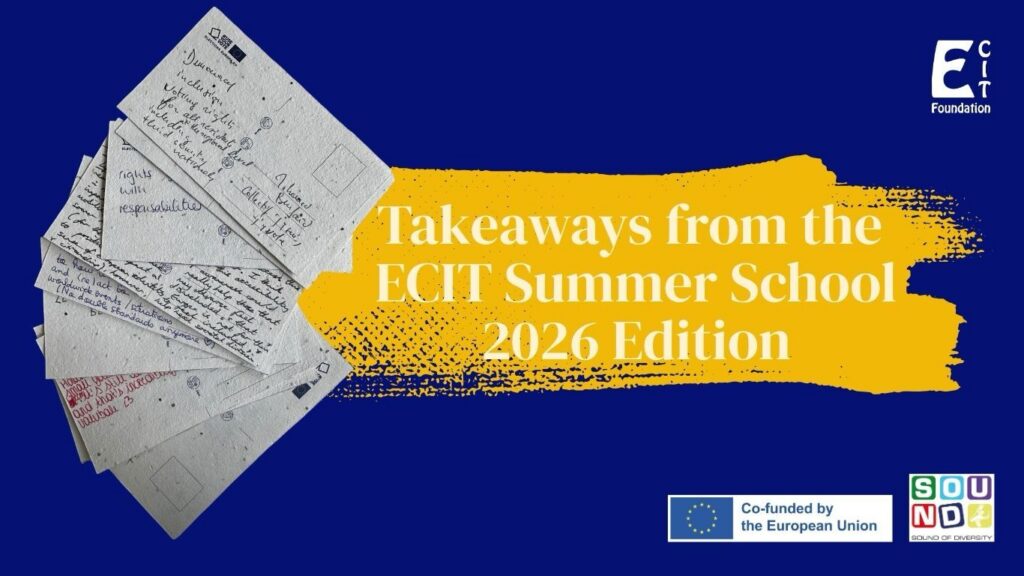
Throughout the day, participant interventions continuously grounded high-level policy discussions in practical civic reality. The active contributions from the audience highlighted critical dimensions for European citizenship:
- Regional Inclusivity: European initiatives must reach rural and geographically isolated communities. A genuinely inclusive Union cannot allow opportunities to remain concentrated in major metropolitan hubs or among already-mobile populations.
- Citizenship Beyond Borders: European citizenship should be defined by shared democratic values rather than rigid territorial boundaries, extending engagement beyond the current borders of the EU.
- Rights Paired with Responsibilities: Expanding individual rights and opportunities must go hand in hand with encouraging civic duty. Rights acquire their full weight when citizens possess both the tools and the active commitment to engage responsibly with their communities and democratic institutions.
- Environmental Sustainability: Scaling up European mobility requires addressing its environmental footprint, finding actionable ways to reconcile broader international participation with the EU’s climate commitments.
- Adapting to AI and Digital Transformation: Rapid advances in artificial intelligence and digital technology are fundamentally altering how people access information, learn, and work. Civic education and skills recognition systems must evolve to keep pace with these shifts.
Translating Discussion Into Action
These audience contributions directly shape the priority roadmap for the ECIT Foundation and the upcoming All On Board campaign:
- Safeguarding Democratic Resilience: Safeguarding democracy remains the central anchor of “All On Board.” Framing the campaign around democratic resilience is vital to its broad resonance and success.
- Inclusive, Universal Outreach: Civic education must reach the widest possible audience. European citizenship concerns every resident, requiring tailored outreach strategies to connect meaningfully across diverse socioeconomic backgrounds.
- Broadening Mobility Beyond Universities: International experiences must cease to be viewed primarily as a benefit for university students. ECIT will actively collaborate with local stakeholders, rural organizations, and civil society actors to open mobility pathways for working adults, non-students, and structurally marginalized groups from the outset.
- Targeted Audience Engagement: Developing a nuanced understanding of diverse European demographics is essential to ensure campaign messaging resonates locally and authentically.
- A Future-Proof Civic Agenda: ECIT will maintain an agile policy framework, continuously updating its advocacy to address environmental sustainability, digitalisation, AI governance, and the changing nature of work.
The Summer School discussions demonstrated both the urgency of today’s democratic challenges and the richness of collective European action. Moving forward, the ECIT Foundation will turn these insights into concrete policy proposals, strategic partnerships, and civic mobilization across Europe.
Support Our Work
The ECIT Foundation relies on a small, dedicated team to turn ideas into real-world civic action. Turning proposals like All On Board into lasting change requires ongoing community support:
- For Individuals: Keep our campaigns independent and agile by making a donation at whydonate.com/fundraising/allonboard.
- For Funding Organisations: Help us strengthen European democracy. To review our project frameworks and explore partnership opportunities, contact us at info@ecit-foundation.eu.
The future of European citizenship depends on what citizens, civil society, and policymakers build together. All On Board is an invitation to do precisely that.